
This is our [H+A] Lab
Welcome to our Human-Comms content R&D Lab + AI-Comms writer's room
What We Like To Do Here:
- We like to have fun + learn: We research, test, Red Edit [AI-generated content], evaluate, debate, listen to music and create
- We like to listen + talk: on Computers, cell phones but especially Human-to-Human. We like Human creativity + "vintage" comms items like notebooks, white boards, dry erasers + color coded sticky notes [we even have a rotary phone that still works]
- We like to read + write: "Show-Don't-Tell" in writing remains a gold-standard around here, yet [H+A] Lab likes to Show + Tell
[H+A] Evolution Series
Below see our [H+A] Evolution of... "Communication" | "AI-Comms" | "Inclusion"
[H+A] Feature-Case Studies
Lab R&D + learnings take place here. AI Red Editing applied throughout site's [H+A] content.
[H+A] Investigative Reports
Lab research + findings begin here. Investigative reports appear below and in Reviews + Products.

The "Communication" Evolution
- By The Red Edit [H+A] Strategic Comms | Lydia Galván Williams
"Old School" or "Classic" Communication started with tools like a notepad, phone and typewriter. Final drafts would be edited by an editor wielding the almighty red-wax pencil. Later, all writing edits were made by a red pen, then a red strikethrough computer edit. What's that "red edit" now for AI-generated communications?
The Red Edit™ [H+A] Strategic Comms is built on 30+ years of Human firsts across five eras of communications. Each era rewrote the tools. None of them retired the Human. This is our [H+A] "Communication" Evolution, with an insider Human [H] "lived professional experience" in collaboration with AI [A]. Wherever you see [H], that's The Red Edit [H+A] Strategic Comms founder's Human lived experience [“We” comms professionals].
1. The Bedrock Era | Medium-centric
Pre-1980s to 1990s
Print, Books, Journalism and Radio/TV. Communicating meant delivering a message through a channel someone else owned: the paper, the broadcast, the airwave.
[H] Pens, notebooks and typewriters… huh? Live and phone interviews… what? Yes, Humans alone developed core messages, authored content and delivered it directly before the dawn of digital media.
2. The Digital Era | Market-centric
Late 1990s to 2000s
Advertising and Sales, Marketing, Consumer PR and Multicultural Marketing. Audiences split into segments, and messages followed them.
[H] Desktop computers, "world wide web" [www], dial-ups and new "wireless” communications… oh my! Some of us were there specializing in Tech PR [pre-pre-IPO] during the Tech Boom, 1.0 at this little place called Silicon Valley. We integrated PR and Marketing and created a new "multicultural practice" at one of the world's largest PR agencies at the time. We were recognized for subject-matter expertise in what was then known as the growing "Hispanic market."
3. The Reputation Era | Strategy & Platform-centric
Mid-2000s to 2010s
Consumer PR-Marketing, Tech PR, Global Corporate Communications and Crisis/Issues Management. Mobile and social media turned every brand into a broadcaster and every misstep into a headline. The job became protecting brand equity at the speed of a share button.
[H] “Did someone page me?” What, we don't have to carry around pagers or the company's big satellite phone case anymore? We were there, promoting and representing the leading companies and products behind the "Mobile and Social Media Revolutions." We also sprinkled in some other specialties, such as global business and communication [APAC, EMEA, LATAM, U.S./NAM] with subject-matter expertise in U.S.-LATAM expansions, as well as crisis communications [in English + Español].
4. The Culture Era | Culture-centric
2010s to early 2020s
Communications turned inward. Reorgs, mergers, employee engagement, global comms, global workforce strategies and inclusion [formerly DEI] became the work, because a message that doesn't align inside never lands outside.
[H] “Are you in the entertainment industry?” Why yes. We have led Corp Comms, Internal-Employee Comms, Culture & Engagement and Inclusive Global Workforce strategies at four out of what used to be six major studios. We also led M&A change management comms and people-plus-systems integrations across mega mergers [WarnerMedia-Discovery, which became WBD; AT&T-WarnerMedia; and Disney-21st Century Fox]. The break into entertainment came after applied our Human crisis comms and inclusive comms expertise to assist another studio that had been hit with an industry-first cyberattack.
We created and led centralized global enterprise Employee + Business Resource Group practices [+ the groups’ integrations post-mergers] at those Hollywood studios, including authoring policies, comms guidelines and "BRGs-BERGs-CNRGs-EBRGs" Playbooks for practices ranging from 10K to 100K+ members.
5. The Human + AI Era [H+A] | Human-centric + AI Governance
Mid-2020s to beyond
AI can draft a message in seconds. It can't tell whether the message is true, fair or safe. Bias, stereotypes and cultural blind spots become AI-hallucinations, and someone has to catch it. In our Inclusion piece, AI cast a parent as a "she" and assumed a seasoned professional needed mentoring to remain relevant. The AI-Comms Editor caught both. This is only one example—we have many more.
[H] We have spent 30+ years learning what “communication” can do to a brand, a culture and people. AI has not. It writes with the same confidence whether it's right or wrong, so the catch has to come from a Human who can detect, edit and prevent because we have seen the fallout. Some of us have been monitoring, testing and evaluating AI-generated communications since it hit "mainstream" in 2022 [with ChatGPT]. Our self-appointed job now: to serve as a “Human Editor” for AI-generated comms in order to protect a brand's soul, ensure editorial accuracy and maintain Human cultural integrity.
The Comms Evolution
Our profession started with a notepad, phone call and typewriter. We continued with the introduction of computers and this thing called the internet. Comms evolved further with new "technologies" like mobile and social media. Now, whether we're looking at our small cell phone screens or large dual-computer monitors, comms starts with a prompt… Yet, just like "old school" Human-comms, the “new school” AI-comms continues with a Human deciding what's true, fair and worth saying. Let’s see where we go next.
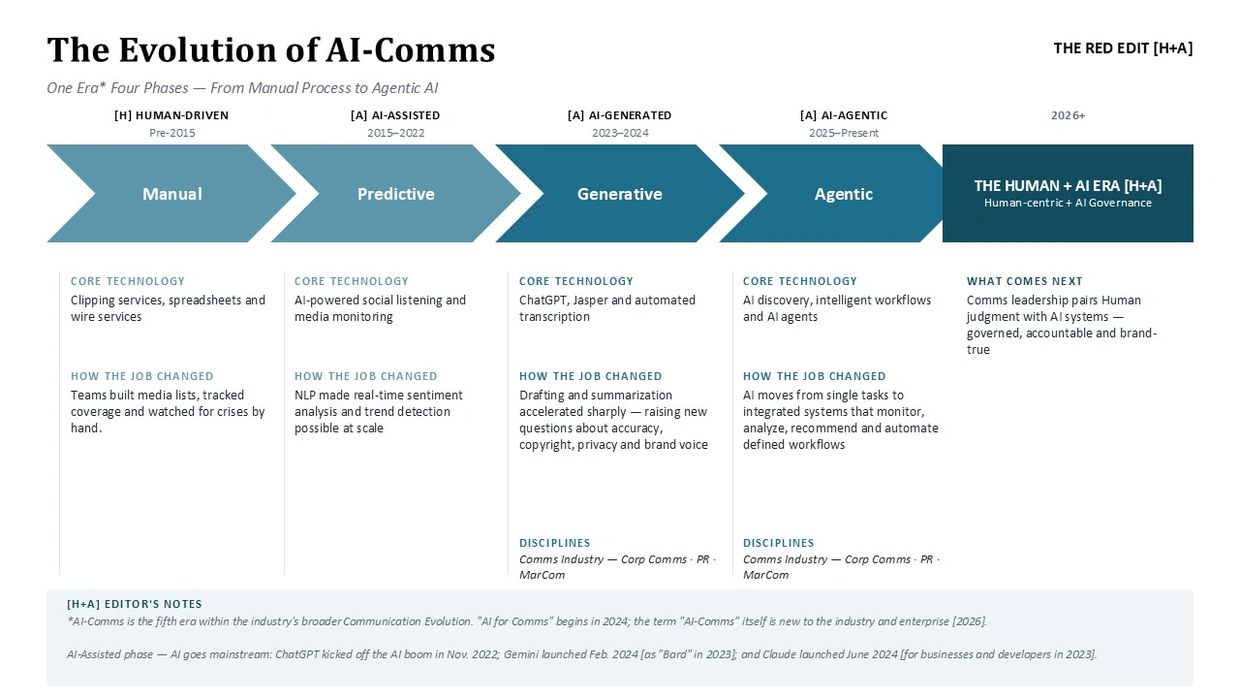
The Evolution of AI Comms
The Human + AI Future of Communications
- By Gemini, ChatGPT and Claude
[H] Editor's Note: This remains Human-led, yet we wanted to have fun while AI-Comms Red Editing this [H+A] Lab project. This is an example of a Human comms content idea that includes our minimal guided-prompts for development. The writing is all AI so it gets the byline; we only capitalized Human to follow our AI-Comms writing style. [We admit that we smiled at seeing that the three AI platforms' unprompted prediction on "the future of communications" aligns strongly with The Red Edit {H+A] Strategic Comms positioning; we didn't edit the AI-generated content.]
AI-Comms — artificial intelligence for communications — is the strategic use of AI, machine learning, and natural language processing to manage, scale, and optimize corporate messaging and reputation.
It marks a shift from a reactive, Human-driven discipline to a hybrid one: AI handles scale and speed, Humans supply strategy, judgment, and trust. AI is becoming less an experimental novelty than a collaborative teammate — which makes the headline Human + AI, not Human vs. AI.
Three Dimensions of AI-Comms
AI-Comms is about far more than asking ChatGPT, Gemini, or Claude to write faster. It covers three distinct capabilities:
- Generative Comms — the content engine. Large language models draft, localize, summarize, and adapt press releases, speeches, employee memos, social content, and personalized media pitches.
- Analytical & Predictive Comms — the guardrails. AI monitors news, social, and forums in real time, catching sentiment shifts, emerging narratives, and reputation risks before they escalate.
- AI Discovery Optimization — the new PR frontier. Managing how a brand shows up when people ask an AI assistant for information or recommendations. The question is no longer just "Can people find us?" but "What will AI say about us?"
The Hybrid Model
The useful question isn't who does the job? It's who does which part best?
AI excels at transcription, translation, data analysis, first drafts, media monitoring, trend detection, and repetitive workflow.
Humans remain essential for crisis judgment, ethical oversight, fact-checking, emotional intelligence, strategic counsel, and trust-based relationships with journalists and stakeholders.
That's the real promise of AI-Comms. It doesn't replace the communications professional. It changes what the professional has time to do.
The machine can process the signals. The Human decides what they mean.
The machine can draft the message. The Human decides what should be said.
The future of communications isn't Human vs. AI. It's Human + AI.
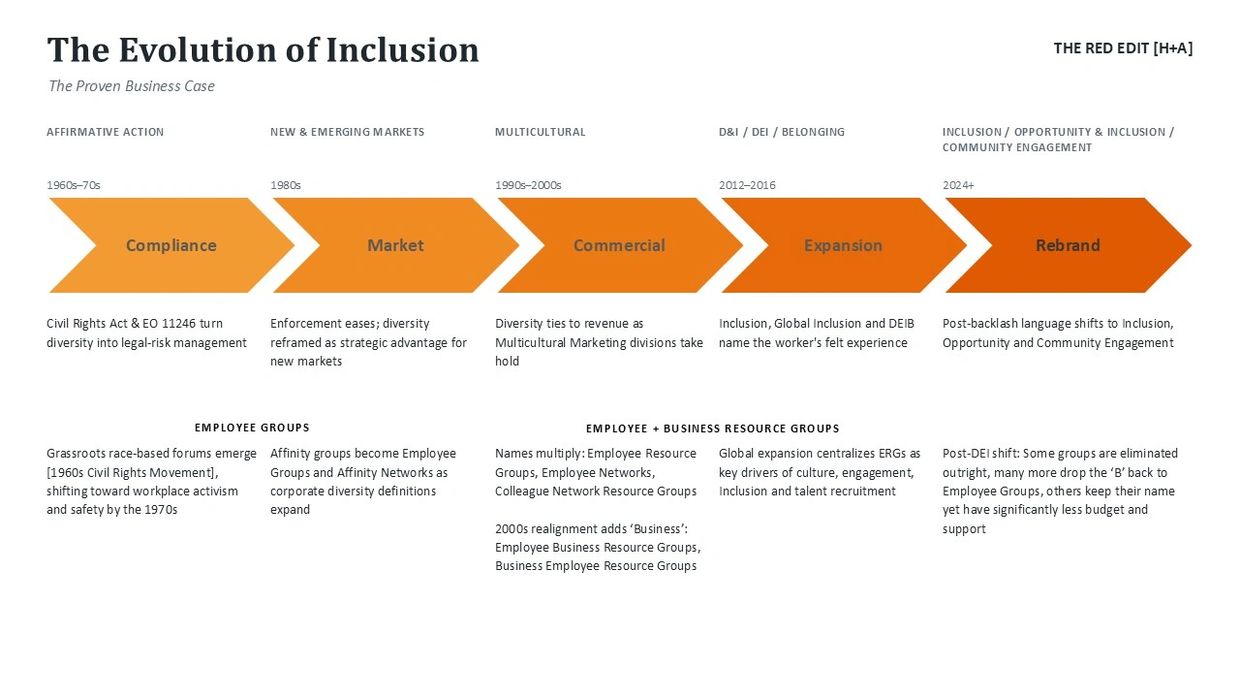
The Evolution of "Inclusion"
[The Artist Formerly Known as DEI]
- By The Red Edit [H+A] Strategic Comms | Lydia Galván Williams, Founder + Principal Comms Strategist
Picture the parent or caregiver who finally got a working schedule they could live with, the veteran whose transition was built into onboarding, the seasoned professional mentoring or sponsoring a younger colleague instead of managed out. Now picture the program behind each of them quietly gone.
This is the story most headlines miss. "DEI" is not a dirty word. It is not only about race and ethnicity either. Dismantling it touches the roughly 80 million women who make up nearly half the U.S. workforce. It also reaches older professionals [primarily Gen X], People with Disabilities, Veterans, LGBTQ+ people and Caregivers.
So, we asked AI the question that matters:
Given what Inclusion has delivered for business, workforce, innovation and brand loyalty, what can Humans expect next?
[H+A] Summary: How We Reported This
The Red Edit [H+A] Strategic Comms Founder + Human "AI-Comms Editor" [LgW] with decades in Inclusive Comms and Global Workforce Engagement evaluated the AI-generated responses. AI traced the history and made a prediction. The Human challenged it throughout multiple drafts with our own field research and “Inclusion” industry professional experience, and AI revised [after "prompt proofing"]. We cross-checked the findings against three AI platforms [ChatGPT, Gemini + Claude]. Where Human + AI sources agreed, we kept it.
Same Work, Different Names
Every era since the 1960s to today has given it a new name and a new reason to exist: "Affirmative Action," "New & Emerging Markets," “Multicultural Marketing,” “D&I,” “DEI,” “Belonging”… and now "Inclusion," "Opportunity & Inclusion" or "Community Engagement." The label changed each time. The work, and the case for it, does not.
[Timeline graphic above]
The Moment the Story Turned
Even this draft needed a Human. The AI's early versions produced two "AI-hallucinations." It cast the parent or caregiver as a "she," and it assumed a seasoned professional needed mentoring or would be managed out. Those are gender and age assumptions, both caught and corrected by the AI-Comms Editor. Then came a line that sounded reasonable enough to pass. The "Ai-Comms Editor" flagged it rather than simply editing it:
[A] "Major enterprises are moving away from the 'DEI' acronym to avoid lightning-rod controversies."
[H] Not so fast. They already have and not just the misunderstood words. They dismantled the systems and programs that the data proves work: better culture, stronger engagement, more innovation and deeper brand loyalty.
[A] The Human is right, and the difference matters. My line described a rebrand. The record shows a dismantling. Companies didn't just change what they call the work. Many stopped doing it.
Everything that follows starts with that correction and factual understanding.
Where The Work Goes Next
It goes underground. The letters "D-E-I" are disappearing from annual filings and press releases to limit legal risk and boycott pressure [The State of DEI Initiatives in 2026]. Some of the work survives by hiding inside People Analytics, Risk Management and Supply Chain: de-biased hiring tools, pay-equity audits, fairer performance systems. Where it isn't absorbed, it's simply lost.
It goes universal. The smartest companies will rebuild around realities no one can politicize. A shrinking labor market means keeping older professionals and the institutional knowledge they carry. Caregiving support keeps talented people from burning out and walking away. And global companies can't drop the work entirely due to European sustainability and pay-gap rules. Call it the Brussels Effect.
It comes back around. Research, including studies of the S&P 500 out of UC Berkeley, finds companies that kept their inclusion commitments match or beat those that fully retreated. Companies that gut their infrastructure will feel it in turnover, stalled innovation and a weaker attraction to younger talent. When Humans lose faith in a brand's culture, customers follow. The language of identity will give way to the language of skills, accessibility and market performance.
The Bottom Line
The label will keep changing, the needs will not. The parent, the caregiver, the veteran and the seasoned professional may still show up on Monday, but they will expect what “Inclusion” programs have always provided. Companies that keep serving them – all Humans, under any name, will keep their talent. The rest will spend years wondering where “did all the good people go?"